
Indirect Painting Technique
The best description for the indirect painting technique is from the out of print book "The Painter's Companion: a Basic Guide to Studio Methods and Materials", by Reed Kay. The book was originally published in 1961 by Webb Books, Inc. and later by Prentice-Hall in 1983 with the new title "The Painter's Guide to Studio Methods and Materials" .
Indirect Painting
Indirect painting involves procedures in which the final effects in a picture are built up gradually by placing several layers of paint, one over the other, the upper layers modifying, but not altogether concealing, the lower layers.
Indirect painters put their first strokes on the canvas with the expectation that they will paint over them again when they are dry in order to change their effect in some way. Therefore when they put on the first layer of paint, called the underpainting, they do not try for a finished effect, complete in final color, drawing definition, and pattern emphasis. Instead at the beginning of the work they concentrate on one or two of these problems, and they depend upon (and make allowance for) the subsequent layers of paint to develop and modify the underpainting until the remaining problems are finally solved.
Indirect methods of painting have been employed in the past by many artists including Van Eyck, El Greco, and Rembrandt. More recently such painters as Soutine, Modigliani, Rouault, Braque, and Paul Klee have utilized the optical effects of indirect processes.
The existence of indirect painting arises from the fact that although paint may be used opaquely to conceal what is beneath it, it can also be applied so as to be transparent, revealing to a greater or lesser extent what it covers. For example, an oil color, such as cadmium red, in paste consistency may be brushed over an area of thoroughly dried yellow paint. If it is applied evenly and fairly heavily, it will conceal the yellow color entirely. Alternatively the red paint may be thinned with an appropriate diluent and may be spread so thinly over the dried yellow color that it lies over the yellow like a sheet of red cellophane, tinting the area a fiery orange color, while allowing the shape and every surface brush mark on the yellow area to remain visible. The orange tone thus obtained, by superimposing a layer of transparent red on an opaque yellow, will differ considerably in optical character from an orange made by combining the same red and yellow pigments in direct mixture on the palette. The directly mixed tone will have a weighty solid opacity, whereas the orange tone produced through the indirect, or "optical," mixture of the two colors will have a more luminous vibration, rather like that seen in stained glass when light passes through it.
By exploiting this characteristic of the oil technique, painters found that they could develop a brilliant luminosity whose exact character was unobtainable in the direct techniques. The procedures most commonly used in indirect painting are called glazing and scumbling.
Glazing
A glaze is an almost transparent film of color laid over another paint surface, modifying the original tone of the area. It is usually a dark color placed over a lighter one. Some colors, such as alizarin crimson or viridian green, tend naturally toward a glaze-like transparency. Almost any color can be used as a glaze if it is thinned enough and placed over a lighter tone.
Scumbling
A scumble is related to a glaze in that it is a film of color laid over another paint surface so that it modifies the original color but does not completely conceal it. Unlike a glaze, the scumble is usually a light, semi-opaque color placed over a darker one. Some colors (Naples yellow, for example) are particularly suitable for this technique, but any color may be combined with opaque white and used as a scumble when it is placed over a darker tone. Scumbles are usually characterized by a pearly opalescence or by a soft smoky optical effect.
Mediums
The film of either a glaze or a scumble must be thin enough to allow the paint below it to be visible; otherwise the glaze or scumble would be completely opaque, and its chief characteristic would be lost. The simplest way to obtain the required thin transparent film is to take a little color straight from the tube-for example ultramarine blue-and rub it over a solid, dry, heavily applied area of light underpainting-let us say in this case, pure white. If the blue is scrubbed on vigorously with the brush or rubbed on with a rag or fingertip, it will spread over the white underpainting as a clear transparent tone of rich blue, which can be made lighter the more vigorously it is rubbed and dispersed. The white underpainting must be dry and hard as a rock to withstand the rubbing of the blue paint, or it will smear into the blue and produce a muddy mixture. If the paint is rubbed over too large an area, the binder may be stretched too far and may leave the pigment badly attached to the picture. However, most oil colors now on the market contain sufficient oil to prevent this occurrence.
A different character of glaze or scumble may be obtained by thinning the paint with a diluent or glazing medium, so that it need not be rubbed. This medium may be made up of various combinations of oils, varnishes, and volatile solvents. As in the case of the painting medium, the personal requirements of each artist must determine the exact composition of such a medium. A painter who wishes to glaze rather heavily and to obtain an even vitreous film over an area may want a glaze medium that can be applied evenly and rapidly to the picture surface. The artist may also want the glaze to set quickly so that the picture may be placed upright in a short time without the paint's trickling. Such rapid setting mediums contain varnish or driers or both, along with the oils, and require a certain skill in handling, since they quickly become tacky and then cannot be reworked or easily removed.
In the original text a formula for a rapid setting medium is given. In present times artists looking for a rapid setting medium would use Liquin by Winsor Newton or Galkyd by Gamblin.
Another painter may prefer a slower setting material so as to be able to deepen or lighten it, remove it or add to it, or reinforce modeling transitions with it. Such a medium might consist solely of stand oil with a little turpentine added.
In general, the less medium used, the better. The glaze or scumble should be made lighter or thinner by dispersing or rubbing rather than by adding excessive amounts of glaze medium as a diluent.
When discussing the merits or disadvantages of a given glazing medium, one must keep in mind the way it is to be used. If only small amounts of medium are added to conventional tube colors, such factors as the yellowing of a particular oil (sun-thickened oil, for example) or the possibility of redissolving a soft resin varnish (such as dammar) are much less hazardous than they would be if the painter were to use large amounts of the medium in proportion to the tube color. The practice of adding glaze mediums to oil paint until it has the consistency of a watercolor wash seems to me to be unnecessary and to magnify all the technical dangers of the oil technique. The desired effects can usually be obtained with less medium and more skill.
Notes
A. The glaze or scumble actually accentuates all brush marks and surface irregularities in the underpainting. Thus the character and direction of all strokes in the underpainting should be meaningful and consistent with the painter's purpose.
B. Colors diluted with too much glaze medium may trickle. Sometimes such overthinned color develops small spots in the dry film which look like dust spots. Actually they are particles of color clumped together like islands of pigment in a sea of oil.
C. The underpainting must be bone dry before it receives a glaze or scumble.
D. Glazes containing so much medium as to create a glassy surface are dangerous, since subsequent films cannot adhere well to them and must crack at the first movement of the canvas.
E. Glaze films containing high amounts of spirit-resin varnishes (such as dammar) in relation to the oil and pigment content are extremely vulnerable to cleaning operations, since the varnish is always resoluble in the cleaning agents used by most restorers. Glazes that are the final or finishing films on a picture are especially vulnerable since they are usually thin.
F. Pictures glazed with slow-drying colors and very slow-drying mediums (such as walnut oil or poppyseed oil) should be shielded from dirt and dust while they dry.
G. Unsuccessful scumbling or glazing effects may be removed while the glaze is still fresh without disturbing the underpainting by wiping the surface with a clean, soft, lintless rag, moistened, if necessary, with a little turpentine. Such removals are possible only if the underpainting was thoroughly dry before the glaze was applied.
Technical Procedures
Technical complication and variety increase with indirect painting. One method frequently employed may be described in the following general terms:
1.; A brush drawing involving only one or two colors is developed to mark out the important locations and divisions on the canvas. The paint is thinned by means of a "lean" medium (such as 1 part sun-thickened oil, 1/2 part varnish, 3 parts turpentine) to a brushable consistency which flows rather easily.
2. The dark and light contrasts are developed by the use of a "lean" fast-drying white (such as flake white) in all the light areas. [Flake White is lead based and therefore rarely used nowadays. Various manufacturers now make alkyd based fast drying whites that are less poisonous]. In the light middle tones the white is mixed slightly with another pigment (ocher, for example, or Indian red). Darks are produced by adding more color or mixed grays to the white, but all darks are kept much lighter than they will appear in the finished painting. The main effort, at this point, is to produce strong placement and gesture of shapes and volumes. These should be expressed broadly with little surface detail but should be accurate as to the relationships of the larger major pictorial masses. At this stage, the effect of this underpainting must be lighter, both in the lights and the darks, than the artist wishes the finished picture to be (Figure 3-16).
3. When this underpainting has dried thoroughly, color relationships are developed over the light monochrome by the use of glazes. These may be brushed on and then modified by wiping them down with a rag or a clean brush so that they emphasize and reinforce the drawing and movement of the underpainting.
4. Color effects are strengthened and made more definite by vigorous direct painting into the glazes (either when the glaze has dried or while it is still wet) with substantial strokes of opaque color. Glazes that have lowered the tone of an area too much may be scumbled over with a lighter color to raise their tonality. Drawing and edges are redefined, especially where glazing or scumbling has caused a passage to lose its initial strength.
Notes
In considering the many possible variations of this procedure, it is wise to keep in mind a few of the possible difficulties.
A. The glaze tends to darken the general tone of the picture. To compensate for this, the underpainting must be kept considerably lighter than the final painting.
B. The glaze and the scumble tend to create soft, unified, diffused effects. Therefore the underpainting should be strong, even somewhat "harder" than the anticipated final effect.
C. If the quality of the glaze is not relieved by some opaque painting and vigorous redrawing, the total effect of the picture may become too washy, spotty, and transparent.
D. In all indirect processes where more than one layer of paint is anticipated, successive layers should be applied "fat over lean."
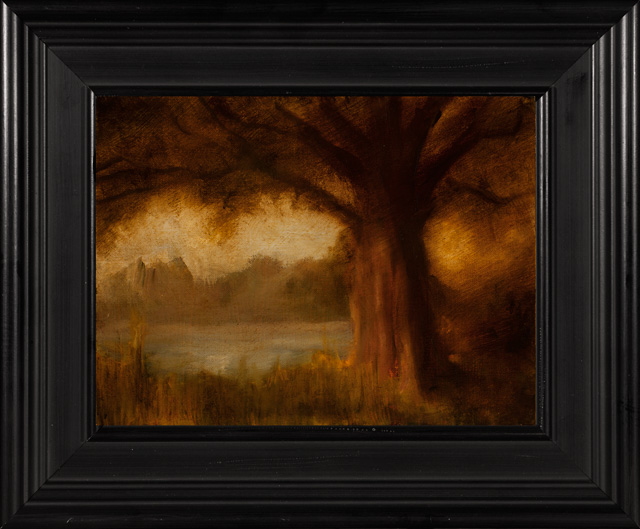 |
Solitary Oak Chris Peters Oil on Linen over Panel 6 x 8 inches 2012  |
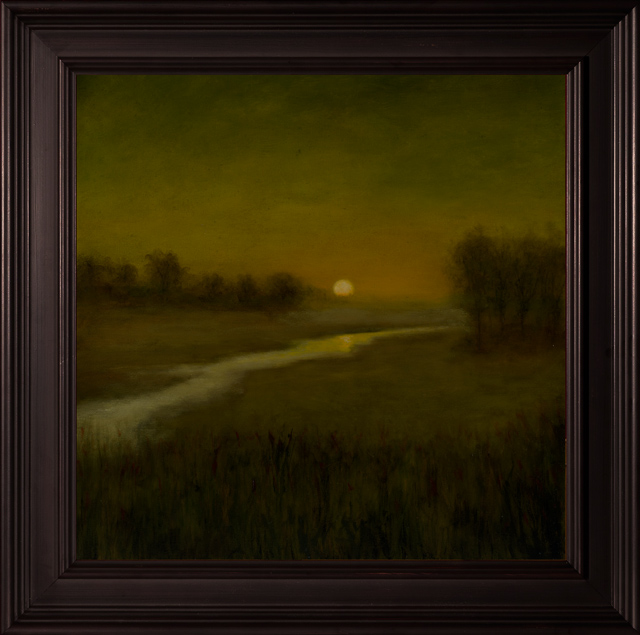 |
Quiet Morning Chris Peters Oil on Canvas 24 x 24 inches 2015 |